With Over 11.4 Million Digital Transactions Completed Between January and May 2025

With Over 11.4 Million Digital Transactions Completed Between January and May 2025 Oman’s Government Digital Transformation Programme Records 80% Overall Performance

July 29, 2025

The Government Digital Transformation Programme “Tahawul” (2021–2025) has achieved an overall performance rate of 80% as of the end of May 2025, marking a notable 19% increase compared to its performance at the end of the first half of the previous year. These results highlight the effectiveness of the strategies in place and the progress made in both regulatory frameworks and digital infrastructure.

The programme continues to be a key enabler of digital transformation across the Sultanate of Oman, advancing the shift toward a digital government built on efficiency, speed, and quality of service.

The average digital readiness of government entities reached 81%, representing a 7% improvement since June 2024. Digital infrastructure readiness also increased to 86%.

A total of 96% of targeted priority services have been simplified, including 381 services improved through Manjam Labs for Government Process Simplification, while 74% of services have been digitalised.

Between January and May 2025, 48 government entities completed 11,439,542 digital transactions. During the same period, 33 consultation and enablement sessions were held, and 4,100 services were documented and indexed in the Government Digital Services Directory.

His Excellency Dr. Ali bin Amer Al Shidhani, Undersecretary of the Ministry of Transport, Communications and Information Technology (MTCIT) and Chairman of the Technical Committee of the Government Digital Transformation Programme, stated:

“The performance indicators of the ‘Tahawul’ Programme reflect the scale of national efforts and the commitment of government entities to confidently advancing toward a promising digital government. We value the high level of alignment with the programme’s vision and objectives which shows our readiness to navigate this transformation with purpose and clarity.”

He added, “Through ‘Tahawul’ we are steadily progressing in enhancing the efficiency of digital services, strengthening infrastructure, expanding digitalisation, and empowering national competence with a shared national ambition to build a more innovative future aligned with the goals of Oman’s renewed Renaissance.”

Key Achievements

Among the major accomplishments of the programme is the launch of the Unified Government Services Portal, which currently hosts 23 services from various entities. The portal has attracted 35,746 users, with 3,906 service requests processed. To improve accessibility, a sign language video library was also launched to support users with disabilities.

Another key achievement was the full rollout of the “OmanNet” Electronic Payment Gateway, which has contributed to increased digital payment volumes and reduced fraudulent transactions. In the first quarter of 2025, the platform processed 14.5 million digital transactions.

During the first half of 2025, 1,572,638 digital transactions were authenticated through the electronic authentication system. Over the same period, the National Electronic Integration Platform enabled the exchange of 163 million data records.

In addition, more than 90 digital public consultations were conducted to support inclusive digital participation across government entities and governorates.

The Government Digital Transformation Programme is part of the National Digital Economy Programme, developed in response to Royal Directives to prepare a comprehensive implementation plan covering all state entities. In coordination with government entities, MTCIT designed a roadmap and execution plan for the 2021–2025 period.

The programme aims to establish a digital government rooted in governance principles and powered by emerging technologies, delivering a connected and future-ready government sector.

Oman’s Government Digital Transformation Programme achieves 73% progress by November 2024

Oman’s Government Digital Transformation Programme achieves 73% progress by November 2024

February 25, 2025

According to the Ministry of Transport, Communications, and Information Technology’s annual report on digital transformation, government institutions have collectively achieved an average performance of 77 percent in meeting digital transformation goals, while governorates averaged 71 percent.

A key highlight is the advancement of four institutions to the ‘advanced level’ for the first time, accounting for 8% of the total institutions measured. They are: Muscat Governorate, the Telecommunications Regulatory Authority, the National Center for Statistics and Information, and the Oman Investment Authority. The report also revealed that 38 institutions (78 percent) achieved above-average performance, while six institutions (12 percent) met the average level, and only one institution (2 percent) fell below average.

The report also detailed improvements in service digitisation, with 1,700 services digitized by 2024, achieving a 67 percent rate toward the total goal of 2,523 services by the end of 2025. Additionally, 2,680 out of 2,869 targeted services have been simplified, representing 93 percent of the goal. A total of 11 mobile government applications were launched last year to further improve service delivery.

Key government digital platforms such as the Oman Business, ‘Hazam’, and ‘Marouf Oman’ were launched to address community needs and enhance the government’s digital transformation. The report also spotlighted the development of the Unified Portal for Government Services, which has made notable progress, with a 73 percent completion rate and plans for launching in February 2025.

Furthermore, Oman’s efforts in digital transformation have received global and regional recognition. The country advanced 9 places in the United Nations E-Government Development Index, now ranking 41st globally. Regionally, Oman won awards for its Electronic Census and the Digital Disclosure Platform, confirming its leadership in digital government.

Looking ahead, the government’s digital transformation program aims to further enhance services through initiatives such as the launch of a unified mobile application for digital services, expanding the availability of government services online, and developing smart platforms for better service delivery.

     180 Submissions Received from 45 Government Entities

180 Submissions Received from 45 Government Entities Ministry of Transport, Communications and Information Technology Announces Closure of Registrations for the Second Edition of the Digital Excellence Award in the Government Sector 2025

December 25, 2025

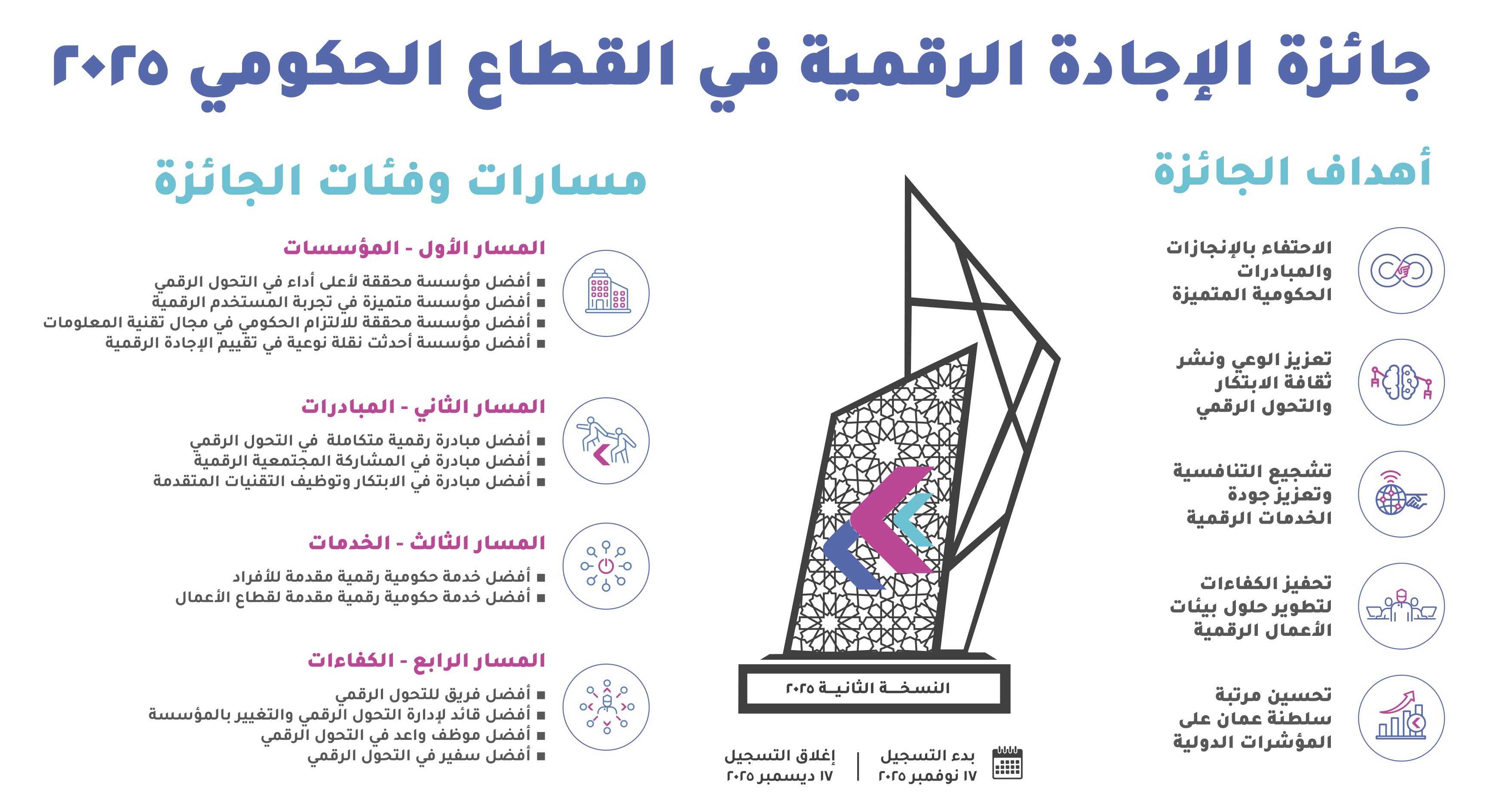
The Ministry of Transport, Communications and Information Technology, represented by the Directorate of Digital Transformation and Sector Enablement, announced the closure of registration for the second edition of the Digital Excellence Award in the Government Sector 2025, after receiving 180 submissions from 45 government entities out of a total of 57 entities targeted by the National Programme for Government Digital Transformation. The level of participation reflected an advanced standard of excellence and innovation in digital transformation.

The award witnessed broad participation across its various categories, with competition spanning a diverse range of awards designed to promote innovation and digital capabilities. These included Best Digital Government Service for the Business Sector, Best Digital Government Service for Individuals, Best Digital Transformation Team, Best Leader in Digital Transformation and Organisational Change, Best Emerging Digital Employee, Best Entity in Digital User Experience, Best Comprehensive Digital Transformation Initiative, Best Initiative in Innovation and Advanced Technology Deployment, and Best Initiative in Digital Community Engagement. This breadth of categories reflects the comprehensive scope of the award and its commitment to recognising outstanding efforts across the Government sector at different levels and fields.

This year’s edition of the award forms part of the efforts to accelerate digital transformation and strengthen innovation across Government entities, in alignment with the priorities and targets of Oman Vision 2040. It also supports Oman’s positioning across global indicators related to government performance and the digital economy. It further reflects the strategic role of digital transformation in developing government work environments, improving service efficiency, satisfying beneficiaries and enhancing quality of life.

The Digital Excellence Award in the Government Sector represents a leading national platform for recognising government entities, initiatives, services and competencies in digital transformation. It celebrates projects that have contributed to the development of Government work environments, enhanced the efficiency of business models and delivered more effective digital solutions that meet the needs of beneficiaries. The award also highlights the commitment of government entities to fostering a culture of innovation and digital leadership, whilst encouraging employees to develop practical solutions that keep pace with global digital transformations.

Through its dedicated award tracks, the award aims to deepen institutional awareness of the importance of innovation and digital transformation, encourage entities and individuals to adopt global best practices in the delivery of digital services. It also serves as tangible support for entities and initiatives that contribute to improving Government performance and bolstering Oman’s competitiveness at both regional and international levels.

Oman expands digital drive with two governorates recording over 27,000 e-Services

Oman expands digital drive with two governorates recording over 27,000 e-Services

August 30, 2025

According to Ibrahim bin Talib Al Wardi, Assistant Director General of Digital Transformation at the Ministry of Transport, Communications and Information Technology, Dhofar recorded over 13,000 digital transactions this year. These included 9,841 completed lease contracts, 3,645 building permit-related services, 479 drilling permits, as well as temporary licensing for kiosks and housing. The governorate also launched several new systems such as the temporary licensing platform, the AI-powered Sahalah chatbot, and e-ticketing services, improving transaction speed and efficiency.

In South Al Batinah, more than 14,600 transactions were completed in the same period, supported by the launch of seven new e-services. These ranged from requests for lamppost maintenance and camping sites to applications for community partnership projects and marriage support funds. The governorate also placed emphasis on public engagement, running workshops, awareness campaigns, and interactive exhibitions at the 2025 South Al Batinah Festival to showcase digital services.

Both governorates have made significant progress in embedding digital culture within government services, creating user-friendly platforms, and boosting awareness. Officials noted that these projects are designed to enhance service quality, cut processing time, and strengthen public trust in e-governance, key goals aligned with Oman Vision 2040.

The Ministry of Transport, Communications and Information Technology Launches the Governorates’ Digital Transformation Ambassadors Programme

The Ministry of Transport, Communications and Information Technology Launches the Governorates’ Digital Transformation Ambassadors Programme

29 September 2024 

 The Ministry of Transport, Communications and Information Technology (MTCIT), through its National Digital Transformation Programme ‘Tahawul’, announced today, Sunday, the launch of the ‘Governorates’ Digital Transformation Ambassadors Programme’. This initiative reflects a commitment to leveraging and maximising the expertise of national specialists, professionals and enthusiasts in digital transformation. These individuals, who possess the necessary passion and skills, will serve as ambassadors, contributing to the achievement of digital transformation goals and ensuring the active involvement of the Omani community in this process.

The Governorates’ Digital Transformation Ambassadors Programme targets citizens, residents, students, job seekers and retirees. It aims to select six ambassadors from each governorate, two of whom will be persons with disabilities. The programme also seeks to raise community awareness of digital services and smart, advanced digital solutions. Additionally, it promotes the shift towards a digital lifestyle as the optimal means of accessing government services, thereby enhancing satisfaction and acceptance among citizens.

Eng. Abdulaziz bin Abdulrahman Al Kharousi, Director General of Digital Transformation and Sector Empowerment at MTCIT, emphasised that the programme focuses on raising awareness and expanding knowledge about digital transformation, introducing the community to available digital services and demonstrating their role in improving quality of life and simplifying governmental procedures. It also highlights the latest technologies being used in this field. The programme further focuses on equipping the community with practical skills in using modern digital tools, such as electronic authentication, digital signatures, e-payment methods, smart applications and Artificial Intelligence (AI) technologies. These efforts aim to enable individuals to securely and efficiently access and benefit from digital services.

The Ambassadors in this programme will be categorised into three primary tiers: 

‘Initiator’ - Individuals with basic experience and a fundamental understanding of digital transformation and advanced technologies. 

‘Advanced’ - Individuals with intermediate experience in digital transformation, an advanced understanding of digital services and transformation technologies such as data analysis, AI, application development, cloud computing and cybersecurity. 

‘Expert’ - Individuals with extensive knowledge and experience in digital transformation, holding relevant certifications or academic degrees in the field. 

The selection process for the Governorates’ Digital Transformation Ambassadors involves several criteria to ensure the recruitment of qualified individuals who can effectively contribute to the programme’s objectives. These include residency within the governorate, an age range of 13 to 60 or older, successful completion of a personal interview and agreement to the conditions of joining the list of ambassadors with a commitment to ongoing participation. Candidates for advanced and expert levels must also provide proof of academic degrees or certifications. Additionally, participants must demonstrate fluency in Arabic, responsibility, a willingness to contribute to the community, communication skills and the ability to produce digital content.

Tahawul Programme adopts an institutional and community participation  approach as a foundation for implementing initiatives, ensuring the involvement of all government sector institutions and community members in achieving a transition from transactional to integrated, efficient performance, while increasing the use of digital services.

Registration for the Governorates’ Digital Transformation Ambassadors Programme Concludes with Over 520 Applications

Registration for the Governorates’ Digital Transformation Ambassadors Programme Concludes with Over 520 Applications

22 October, 2024

The Ministry of Transport, Communications and Information Technology (MTCIT), through the national Government Digital Transformation Programme ‘Tahawul’, announced today the successful conclusion of registration for the Governorates' Ambassadors for Digital Transformation Programme. The initiative aims to strengthen Oman’s digital transformation efforts, raise community awareness about advanced smart digital services and solutions and encourage a greater shift towards a fully digital lifestyle.

Eng. Abdulaziz bin Abdulrahman Al Kharousi, Director General of Digital Transformation and Sector Enablement at MTCIT, highlighted the strong interest shown by both citizens and residents in the Governorates' Ambassadors for Digital Transformation Programme, which received over 320 applications. He expressed his heartfelt gratitude to all the applicants for their enthusiasm and eagerness to be part of this effort. Al Kharousi also mentioned that the selected ambassadors will undergo comprehensive training, equipping them to serve their communities by helping individuals effectively use digital technologies and services. This initiative will play a key role in enhancing quality of life and fostering the growth of the digital economy.

A total of 66 ambassadors will be selected from various governorates across Oman, categorised into three key levels. The first level, "Initiator", is for those with a basic understanding and limited experience in digital transformation. The second level, "Advanced", includes individuals with intermediate experience and a solid grasp of advanced technologies such as data analytics, artificial intelligence, cybersecurity, application development and cloud computing. The third level, "Specialist", is designed for individuals with deep expertise and extensive experience in digital transformation, supported by academic and professional qualifications.

Across all levels, the ambassadors will take on diverse roles, from raising awareness about digital services to promoting the use of smart applications, electronic payment systems and other cutting-edge technologies.

The Government Digital Transformation Programme, ‘Tahawul’, remains dedicated to providing the Ambassadors with the skills and knowledge they need to excel in their roles. Following a thorough evaluation of applications and interviews, the selected ambassadors will undergo specialised training. This will cover essential areas such as digital content creation, the use of modern technologies and smart applications and artificial intelligence techniques. The goal is to ensure that the Ambassadors are fully equipped to actively support digital transformation efforts and make a tangible impact on the development of digital services.

MTCIT Signs Cooperation Agreement for Government Digital Transformation

Ministry of Transport, Communications and Information Technology Signs Cooperation Agreement for Government Digital Transformation

27 October, 2024

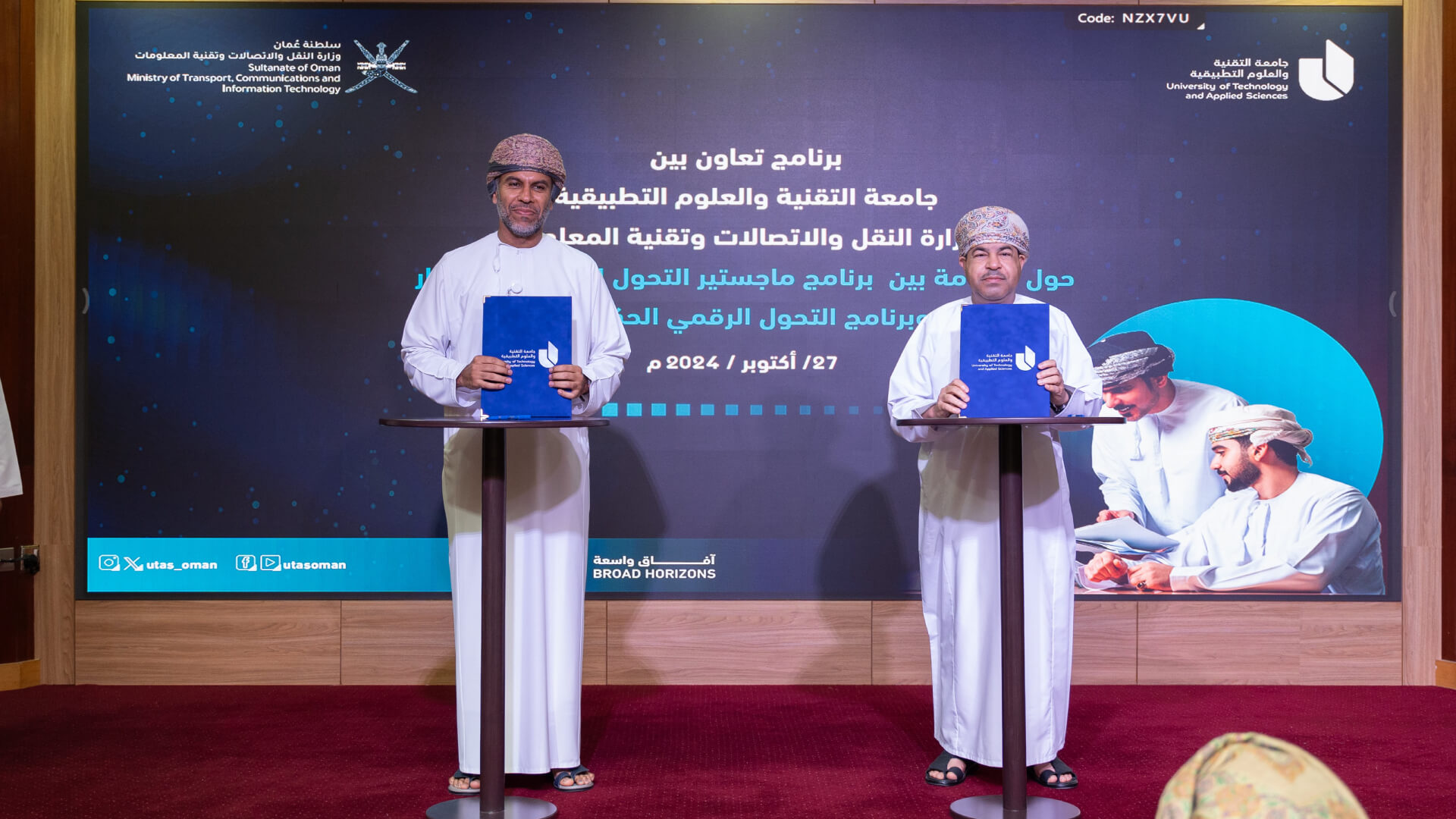
The Ministry of Transport, Communications and Information Technology, through its Government Digital Transformation Programme, ‘Tahawul’, has signed a cooperation agreement with the University of Technology and Applied Sciences. This partnership will introduce a Master of Science (M.Sc.) programme in Digital Transformation and Innovation, aimed at promoting collaboration with academic institutions and equipping individuals with essential skills in creativity and innovation, all in support of Tahawul's strategic objectives.

The agreement was signed by Dr Ali bin Amer Al Shaidhani, Undersecretary for Communications and Information Technology at MTCIT and Dr Said bin Hamad Al-Rubaie, President of the University of Technology and Applied Sciences.

This initiative seeks to harness the value of the M.Sc. in Government Digital Transformation, aligning efforts to develop innovative, agile, and proactive government bodies. It supports the vision of Oman Vision 2040, which highlights the importance of fostering innovation and empowering national talent in the digital transformation space. The agreement also ensures that the Master’s programme remains aligned with the evolving needs of government digital transformation through regular curriculum reviews, project evaluations, research activities and student admissions. 

H.E. Al-Shaidhani emphasized that the agreement underscores the Ministry’s dedication to collaborating with educational institutions to achieve long-term digital transformation. The aim is to prepare national talents with the skills necessary to create innovative government services capable of addressing future challenges. He stressed that coordinating both academic and practical efforts is a key element in the successful execution of the digital transformation programme, in line with Oman Vision 2040.

Under the agreement, the Ministry will provide access to its databases of digital transformation plans, projects, and evaluation outcomes to enhance research and project work within the M.Sc. programme. Students will also have opportunities to present their research and projects at high-profile events such as COMEX, GITEX, LEAP, and other global conferences. Furthermore, the Ministry will offer students consultations on digital transformation research, assist with surveys, and organize interviews. Workshops on change management and innovation will be integrated throughout the Master’s programme. Additionally, Master’s students will be involved in discussions about improving government services through the Manjam Labs initiative.

H.E. Al-Rubaie expressed his appreciation for the Ministry’s support of the education sector, highlighting the significance of this partnership. He stated, “This initiative is part of our ongoing efforts to enhance our academic offerings to meet national objectives and prepare a workforce capable of driving digital transformation in Oman. We deeply value our collaboration with MTCIT and look forward to further joint accomplishments in innovation and development.”

He also announced that the university will provide five free seats in the programme each year to government digital transformation specialists nominated by the Ministry, provided they meet the admission criteria. The university will encourage students to base their graduation projects and research on topics proposed by the Ministry and will participate in awareness and promotional activities related to the Government Digital Transformation Programme and initiatives aimed at improving digital services and solutions.

This agreement marks a significant step forward in strengthening the collaboration between the Government Digital Transformation Programme and academic institutions. It will prepare specialised national talent to lead digital transformation in Oman and foster innovation, in alignment with the government’s development goals outlined in Oman Vision 2040.

MTCIT Holds Training Session on Digital Participation in the Government Sector

Ministry of Transport, Communications and Information Technology Holds Training Session on Digital Participation in the Government Sector

10  September 2024

The Ministry of Transport, Communications and Information Technology (MTCIT), through the Directorate General of Digital Transformation and Sector Empowerment, held a training session on digital participation in the government sector. The event brought together representatives from various government institutions and information and communications technology specialists. This initiative is part of the Ministry's ongoing efforts to strengthen and promote digital participation and fully leverage advanced technologies, in line with the goals of the Government Digital Transformation Programme 2021-2025.

The two-day training session aimed to increase awareness of the Digital Participation Guidelines and offer practical training on its key principles. It also focused on strengthening the role of government institutions in using digital participation tools to enable effective and inclusive communication with the public.

Engineer AbdulAziz Abdulrahman Al Kharusi, Director General of Digital Transformation and Sector Empowerment at MTCIT, emphasised that digital participation is a key strategy for increasing community involvement in government decision-making. By engaging beneficiaries in discussions and gathering their feedback, this approach helps improve government services and ensures that policies and services better address the public's actual needs. 

Additionally, digital participation fosters transparency and credibility, strengthens the relationship between the government and the community, builds trust in government institutions and improves the effectiveness of project and initiative execution. The Ministry remains dedicated to advancing digital participation tools and methods to fully utilize modern technologies and better meet citizens' expectations.

The session covered a detailed review of the digital participation policy and introduced the Digital Participation Guidelines. It focused on using digital tools and best practices for running participation activities. Positive government examples of digital participation were shared, including a success story from the Telecommunications Regulatory Authority (TRA). The TRA emphasised that the key to successful digital participation is giving people the right information, allowing them to ask informed questions and involving them in meaningful discussions about services, policies and improvements. The Authority also stressed the importance of using communication technology to involve people in government decisions about policies and public services.

The training session also discussed the main challenges faced when implementing digital participation in the government sector. These included difficulties in effective communication between government institutions and beneficiaries as well as issues with integrating digital tools. Solutions were proposed, such as improving ongoing staff training programmes and developing better communication strategies. Participants stressed the importance of continuing efforts to meet digital transformation goals and encourage meaningful community participation, ultimately leading to the benefits of digital participation and producing real positive results.

Digital participation offers several tangible benefits, including faster and easier collection of feedback from beneficiaries on challenges and needed solutions. It also boosts the return on investment in digital services by targeting the real needs of the public. By promoting interaction between government units and beneficiaries, whether individuals or organisations, digital participation increases public support for government projects and initiatives, encouraging commitment to their implementation. This, in turn, deepens the adoption of digital transformation by involving beneficiaries in policymaking and the design of new digital services.

In addition, digital participation helps create decision-making processes that are more collaborative and transparent between government units and the public, leading to more effective outcomes. It also promotes digital inclusivity, empowering beneficiaries to tackle future challenges as technology continues to evolve rapidly.

Khareef Dhofar Apps

Khareef Dhofar: Pioneering Digital Applications Elevate Visitor Experience

 As part of the "Tahawul" Government Digital Transformation Program’s mission to harness modern technologies for enhanced efficiency and innovation in government services, the Dhofar Governorate set new benchmarks in enriching the visitor experience during the Khareef season. Through the development of cutting-edge digital applications and services, Dhofar has delivered a truly exceptional experience, meeting the evolving needs of the community and significantly enhancing quality of life.

Digital Innovations Enriching Khareef Dhofar Visitor Experience

Dhofar Seasons

One of the standout digital innovations introduced by the Governorate is the "Dhofar Seasons" app. This comprehensive guide has redefined the tourist experience during the Khareef season, allowing visitors to explore a wide array of cultural and entertainment events, tailor activities to their interests, and access detailed information on Dhofar’s most breathtaking tourist attractions such as   its majestic mountains, pristine beaches and its lush green plains. the app also provides crucial information on accommodations and dining options. Since its launch, "Dhofar Seasons" has been downloaded 145,000 times, with users expressing high satisfaction with the app’s ability to offer a seamless and enriched experience.

Absher

The "Absher" app plays a vital role in improving the quality of life within the Dhofar Governorate, offering an array of essential services aimed at environmental cleanliness, road and green space maintenance, and parking reservations. This season alone, "Absher" has attracted 4,071 users, facilitating 547 transactions, including 230 for road and lighting services, 146 for pest control, 104 for environmental sanitation, and 67 for garden and landscaping services. Users have lauded the app for its user-friendly interface, noting significant improvements in mobility and access to environmental services.

Sekka

"Sekka" is designed to simplify the rental process for residential units during the Khareef Dhofar season. The app enables users to search for and list a variety of real estate options for rent, offering detailed information on nearby services. "Sekka" has been instrumental in enhancing the visitor experience by providing fast and reliable accommodation solutions. Since its launch, the app has been downloaded 29,088 times, receiving widespread praise for its unique and practical features.

Through these pioneering digital projects, the Dhofar Governorate has demonstrated its commitment to implementing innovative solutions that cater to community needs and improve the quality of life. These applications have significantly enhanced the visitor experience by providing comprehensive, accurate information on tourist events, mobility services, and accommodation, thereby boosting user experience efficiency and underscoring the Governorate’s dedication to excellence in digital transformation.

"Tahawul" program emphasizes the urgency of accelerating digital transformation initiatives, prioritizing them as essential to the current phase of development. The program will continue to offer robust support and guidance to government institutions, ensuring the implementation of best practices and standards in digital project execution.

Moreover, "Tahawul" program is committed to bolstering Oman’s digital economy by acting as a catalyst for government-led digital initiatives and services aimed at businesses and individuals. It plays a critical role in enhancing digital infrastructure, fostering innovation, expanding digital services, and empowering competencies in digital transformation. The program is also key to facilitating Oman’s transition to a connected, efficient, and inclusive digital society that benefits all members of the community.

Project image

MTCIT meeting reviews digital transformation in government sector

December 31,2024

The Ministry of Transport, Communications and Information Technology (MTCIT) on Sunday organised the first meeting of heads of teams tasked with the ‘management of change and digital transition’ in government institutions.

The meeting was part of a series of gatherings that has been initiated to expedite the process of digital transition in the government sector, with the prime objective of realising the goals and indices of the Government Digital Transition Programme 2021-2025.

The meeting discussed the importance of activating the role of change management teams to ensure the success of digital transformation plans in government institutions, and of the executive plan for the national change management strategy to implement several digital transformation programmes in 2024.

The meeting also reviewed the unified national portal for e-government services, the challenges facing change management teams in government institutions, and ways to contribute to the change management goals in the Government Digital Transition Programme for 2024 in solving these challenges.
The meeting also reviewed change stories for projects in digital transformation to focus on how to manage the human element and direct it towards new technology effectively and constructively to ensure full benefit from digital transformation.
 

It stressed the importance of enhancing interaction between change management teams in government institutions to accelerate the work of digital transformation teams and the necessity of transferring knowledge and benefiting from successful experiences.

During the meeting, a ‘change management knowledge community’ was announced. The community will help accelerate digital transition and secure its success and sustainability.

Source: Muscat Daily